In today’s fast-changing world of mobile app development, picking the right framework can make or break your project. React Native vs Flutter has become one of the hottest debates among developers and businesses alike. Both are powerful, cross-platform frameworks that let you build apps for iOS and Android from a single codebase — but which one is the better fit for your needs?
This guide will break it all down in plain, human-friendly language so you can confidently decide between React Native vs Flutter in 2025.
React Native vs Flutter – Similarities
Let’s start with where they’re alike. Both React Native and Flutter are open-source frameworks designed to speed up cross-platform app development. They offer “hot reload,” meaning you can instantly see code changes without restarting the app — a massive time-saver. And both frameworks allow you to use one codebase for multiple platforms, reducing development and testing efforts.
Ease of Learning
When it comes to getting up to speed, React Native has a slight edge. It uses JavaScript, one of the most widely used languages in the world, so many developers already feel at home.
Flutter, on the other hand, uses Dart, which is newer and might take some learning. But once you get the hang of it, Dart’s unique features can make you fall in love with Flutter’s smooth development experience.
Community Support
In terms of community, React Native leads the pack. Having been around longer, it boasts a larger and more mature community, making it easier to find solutions, tutorials, and third-party libraries.
You can dive deeper into the differences in Demystifying React and React Native: Choosing the Right Technology for Your Project
That said, Flutter’s community is growing at lightning speed, backed by Google and a rising wave of passionate developers.
Performance
Here’s where things get interesting. Flutter has a clear performance advantage because it compiles directly to native code, eliminating the need for a JavaScript bridge. This results in faster, smoother apps.
React Native, while impressive, still relies on a bridge between JavaScript and native components, which can slow things down — especially in performance-heavy apps.
Widgets vs Third-party Libraries
Flutter comes packed with a rich set of customizable widgets right out of the box, reducing the need to hunt down third-party solutions.
React Native relies more heavily on third-party libraries to fill in the gaps, which can sometimes increase complexity and testing time.
Documentation Support
When it comes to documentation, Flutter shines. Google provides detailed, developer-friendly guides that make learning and troubleshooting easier.
React Native has decent documentation too, but many developers say Flutter’s resources are more polished and beginner-friendly.
Other Points to Consider
- Ease of Installation: React Native wins with fast setup using Node Package Manager (NPM). Flutter’s installation process has a few extra steps.
- Development Time: Flutter’s widget system often means faster UI development. React Native can take longer due to its reliance on native elements.
- CI/CD Support: Flutter offers built-in support for continuous integration and delivery. React Native may require more manual configuration.(For a closer look at CI/CD practices, see How to Deploy a NestJS App on AWS EC2 in 2025.)
Head-to-Head Comparison: Flutter vs React Native 2025:
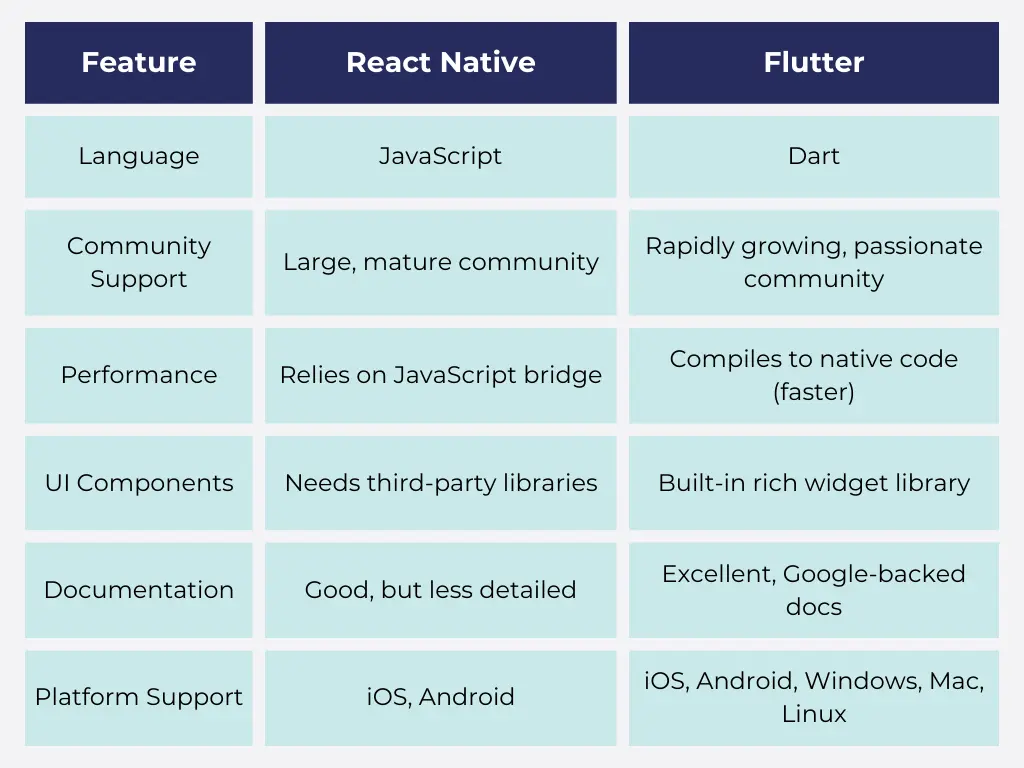
To summarize the differences between Flutter and React Native in 2025:
- Flutter is open-source, focusing on cross-platform apps with a single codebase.
- React Native is open-source, designed for building native apps running on iOS and Android platforms.
- Flutter is compatible with Android 4.1 and iOS 8, while React Native supports Android 4.1 and iOS 10.
- Flutter includes Google-developed plugins, offering additional functionalities like geolocation and mapping.(If you’re choosing between frontend technologies, also explore Decoding Next.js vs React.)
In terms of performance, Flutter’s compilation to native code sets it apart from React Native, which relies on JavaScript bridges. Your choice should align with your specific project requirements, development team expertise, and target audience.
Choose Flutter if:
- You want beautiful, customizable UIs with widgets
- Performance is critical (think 60-120 FPS apps)
- You need to launch fast with fewer third-party dependencies
- You’re okay with learning Dart
Choose React Native if:
- You already have a JavaScript development team
- You need easy integration with existing projects
- You want access to a massive library ecosystem
- You don’t need the absolute fastest performance
The Future of Flutter and React Native
As we step into 2025, both frameworks continue to evolve.
Flutter’s recent releases extend its reach to desktop apps, with companies like Alibaba showing strong support.
React Native, backed by Meta (Facebook), remains a go-to choice for scaling massive apps and improving developer productivity. Both frameworks are here to stay — and both are getting better by the day.
Conclusion
So, React Native vs Flutter — who wins?
The truth is, it depends on your project’s needs. Flutter offers blazing speed and beautiful design, while React Native delivers flexibility and a huge ecosystem.
The most important thing? Choose the one that aligns with your goals, team, and timeline.
If you’re still unsure, Radixweb’s expert developers are ready to help guide your choice and bring your app idea to life.
You can also explore ServiceNow vs Salesforce in our next guide.
Leave a Reply